Living on a budget isn’t about restriction—it’s about intention.
When you take control of your money, you gain the power to make it work for you instead of the other way around.
Whether your goal is to get out of debt, build savings, or simply stop living paycheck to paycheck, budgeting gives you the clarity and confidence to reach it.
It may take some time to adjust, and you might face setbacks along the way, but every step you take toward managing your money better is a step toward financial freedom.
With a solid budget, smart choices, and consistent habits, you can live well, save more, and reduce stress—proving that living on a budget isn’t just possible, it’s empowering.
Did you ever ask yourself what is the main core for doing your monthly budget?
You may say budgeting is a way to control your spending, pay off your debt and control your finances by making sure you make the most out of your income
All the above are correct but if you don’t include saving for retirement as one of the monthly budget goals
You have to think about your retirement saving plan seriously with at least 10-15% of your income
To avoid skipping the saving for retirement
Keep in mind that when you contribute to RRSP in Canada or IRA in US, it is considered a tax deduction to your total income
This means you get a tax refund when doing your taxes
A lot of companies match your contribution up to 6% so if you contribute 6% that’s 12%
It will not hurt you as it will be deducted from your gross income
Just budget your take home pay after your contribution
12) Forgetting seasonal expenses and tax income
Seasonal expenses are something that come up where you totally forget about them or based on mails you receive
It is better to keep track of them if they are recurring like summer camps for kids, car license plate renewal, regular oil change, annual car maintenance and AAA/CAA membership renewal if applicable
The positive side is the tax refund income when you file your taxes
To avoid forgetting seasonal expenses
Brainstorm on top of all the listed below seasonal expenses and add them to a sheet that contains the expense name, amount and due date to be paid
Put the due date even if the renewal is coming in 5 years or more like Passport renewal
Occasional clothes like school uniform, a suit or dress for attending a wedding or engagement
Hobby supplies e.g. my Siteground web hosting annual renewal
Office supplies e.g. my printer toner around once every 2 years or based on your consumption
EZ pass in US or 407 in Canada, any other used toll
AAA in US or CAA in Canada if applicable
License plate renewal
Car maintenance and emission test
Driving license renewal
Passport renewal
Doctor’s appointments and any drug you refill every 3-4 months
Software renewal like your antivirus or Office membership if applicable
Amazon prime if applicable
Professional degrees fee like PMP or CPA if applicable
Property tax or HOA stands for Home Owner Association fee, I recommend to ask your bank to deducts a small percentage with every mortgage payment
13) Giving up too early
If you give up too early or after a while that your family budget is not for you for any or all of the following reasons
Look into your budget to see all expenses you have control on
And where you spend them by yourself with any payment method
3- Figure out your bills
This step is very important as not all the bills go out on the same day
You can have the rent on the 5th of the month while your cell phones on the 27th
This means you have to deduct the bills from your paycheck which is almost biweekly for most of us
Now check to see how much cash left in every paycheck
Add the contributed amount to the cash envelope based on the percentage to your paycheck
For example, if you earn $1890 income biweekly and you pay $900 rent as a one time payment
This means you can contribute less money to your cash envelopes until your next paycheck which does not have that big bill
4- Divide your cash envelope system by your paychecks
In simple words, if you assign $450 for the grocery then you have to contribute $225 from every paycheck
Actually that is not the ideal scenario
I mentioned earlier due to the fact that you have bills due that can deduct automatically from your bank account
This leads to have your paychecks net amount not exactly the same during the month
One paycheck can pay the rent so you have to compromise the contributed cash to your cash envelope method
5- Prepare your cash envelopes
I mean by preparing your cash envelopes finding a way to distinguish your cash envelopes from each other
If you bring white envelopes and you write on each envelope the name of the expense
This approach is not practical as you have to check your envelopes every time you pay for an item
I recommend to get a different distinct color for every cash envelope
After some time you will start building a habit to recognize the expense by its color
For example, when you spot the green envelope in your bag, you instantly realize it is for paying your grocery
Advantages of cash envelope system
When using the cash envelope system you have a surefire technique not to exceed your estimated budget
Because you force yourself to meet it by paying cash from your envelopes
You associate it with the saving habits
And so you save easily without worrying you have to deduct money from your planned saving due to an expected amount you have to spend
Disadvantages of cash envelope system
1) Getting started with the cash envelope method can be confusing and discouraging at the beginning
2) Cash envelope method always keeps you worried because of carrying a lot of cash in multiple envelopes
3) It is very hard to convince your whole family carrying cash is the only way to stick to your budget
4) You have to go to the ATM machine frequently unless you cash out the lump sum amount in advance
5) You will not collect any credit card rewards at all
Experience of those who used the cash envelope system
The cash envelope method is not for everyone
But for those who followed it to adjust their bad spending habits and put themselves back into following their budgets
They noticed the following below benefits occurred to them
1- Spend less money
Of course they spend less money because they can never exceed what is inside the envelope
Assuming you don’t take money from another envelope
Even if you manage to spend less from the other envelope which you have withdrawn cash from
2- Save more money
Saving money becomes easy now as you can deduct your savings from each paycheck in advance
This happens before you distribute your cash in every envelope
3- Become more analytical
The fact of not swiping your credit cards make you more analytical
It forces you to calculate your spending before you go to the cashier
Also it forces you to drop some items from your cart to adjust the planned cash you intend to pay for this expense during your shopping trip
What to do if you have spent all the cash
I am a practical person
I would say blatantly that when following the cash envelope method It can happen to you that you finish your cash in one of your envelopes before the end of the month
If you manage to spend the rest of your month without spending from this particular envelope
This will teach you a lesson to properly manage spending your cash wisely
if you break your budget I hope you learn from your mistake
And find out what went wrong and promise yourself not to do it again
Keep in mind I assume you have properly selected a reasonable amount on any particular expense
And have not gone unrealistically crazy assigning an impossible amount to achieve
Like assigning $150 for grocery and forcing yourself to do it
Where should you keep your cash envelopes
One of the frequently asked question is where you keep your envelopes
If you are using a carry on bag, you can keep your cash envelopes inside
Don’t worry nobody expects that you carry a cash inside your bag
If you are the man and you carry only a wallet
Anyone of us knows in advance where you are heading so you should only pick the envelope you are going to spend the cash from
Can I use my debit card instead of cash envelopes
I am not against using your debit card instead of carrying your cash envelopes
But I would assume you show some responsibility following the cash envelope method first for 2-3 months to build the habit of spending wisely on every shopping trip
Then you can switch to the debit card spending
But please use a budget app like Goodbudgetwhich is based on cash envelope method
What to do with the extra cash
In my humble opinion
You can get a sense of getting extra cash on any envelope based on your spending habit during the month
For example, if you are on your fourth and last week of the month
And you have $200 left from your $450 grocery cash envelope
This means you almost 45% left and likely you will save money
The decision is yours to reward yourself for a dinning out with your spouse or to save the money
Summary of the cash envelope method
Between me and you
I cannot follow the cash envelope method
Not because I teach something hard that I fear to apply it to myself
Simply I haven’t gone to a level of breaking my budget
A level that required me to go through using the cash envelope method
According to a survey carried by CareerBuilder a leading job site related to American workers
They collected statistics related to debts, budgeting and living paycheck to paycheck
78% of Americans are living paycheck to paycheck
The survey above is long and detailed but what really grabbed my attention
28% of workers earning between 50 K and 99 K and need to stop living paycheck to paycheck
3 out of 4 surveyed say they are in debt
While in Canada, according to survey conducted by Angus Reid on a sample of 2,047 Canadians
It showed that 53% of Canadians need to stop living paycheck to paycheck
That’s really a devastating news
This brings me to talk about this phenomena and to start with
Stop living paycheck to paycheck
What is meant by living paycheck to paycheck
Simply this term means you cover all of your expenses with your income
You desperately waiting for the next paycheck usually biweekly to continue to cover your expenditures
You are in a continuous cycle of no money left over and no savings to make
What are the causes of living paycheck to paycheck
Don’t every think that those workers who are broke waiting for next paycheck are those who are on low income jobs
Check above 28% of people earning 50K to 99K are still struggling to make ends meet
Here are all the reasons that cause this phenomena
They don’t include the low income jobs as a cause
Is this a surprise to you? read the first cause about cost of living
Your cost of living is beyond your income
I will always mention this fact over and over from my personal life experience
Me and my wife were living with enough buffer to save and more room to enjoy our lives with a combined income of 52% less than what we currently earn
I know what went wrong, we moved to a bigger place with extra mortgage to pay
Bottom line, check your bills including your mortgage/rent and make your math
I want you to calculate the percentage of your mortgage/rent to your income
I bet you that a few people know their percentages
Banks still lend you for a mortgage that can eat up to 42% of your income
They don’t care if you understand the consequence of your action
What is important now for banks maintaining a safe threshold for borrowers to keep paying their mortgages
Keeping up with the Joneses
Keeping up with the Joneses is Dave Ramsey’s expression from his book Total Money Makeover
What he means is that not all relatives and friends have equal incomes
This is part of life to have filthy rich, rich, middle class and poor people
What is inappropriate is not saying I cannot afford it to friends and families when they ask you to hang out for dinners or pubs so many times more than you can handle it
Or paying for expensive gifts in return of what they bought on your birthdays and anniversaries and you try to complement them the same way
We bought the lie, we lived our lives according to the standards set to “Keep up with the Joneses” and it turned out that they broke and living in debt tooI love this quote from Dave Ramsey’s total money makeover
Saving is not a priority
In other words, you are not paying yourself first
Paying yourself first is the automation of the saving process by deducting a percentage or amount from every paycheck to transfer to another saving account
You don’t do it but ask you bank to set it up for you
All banks can do this automation if you ask them to do so
You are not tracking your spending
Without tracking your spending, it is almost impossible of detecting where your money is spent
You can track your spending by following these 2 steps
Step 1 – if you are initially tracking your expenses for the first time
You need to get all of your credit cards statements for the past 3 – 6 months and investigate where you spend your income
Almost all credit cards companies allow you to save your statements in CSV format
He uses the expression rainy day from his grandma where she used to tell him this quote
You need a coat for those rainy day and it is going to rain for sureDAVE RAMSEY’S grandma quote from TOTAL MONEY MAKEOVER
Although having an emergency where you need to pay for your car repair or for urgent medical or dental bill not covered by your insurance can cause unexpected disruption in your monthly bills
In a typical year expect to have one or more of these urgent unplanned emergencies to pay for
They can put you in debt if you are not ready with an emergency fund
Relying on credit cards for your lifestyle
I am not against using credit cards to pay for your daily expenses
What I do I stick to creating my family budget where I can control myself to use my credit cards to pay for what I planned in my monthly budget
There are people who use their credit cards to pay haphazardly for anything and everything
Not setting any financial goals or plans
The only thing that motivates you to save and help you to achieve your financial goals is setting a clear financial plans
If you have a clear plan, saving money will be priority for you and definitely you will find a lot of room to cut in your flexible and discretionary expenses
How to stop the cycle of living paycheck to paycheck
paycheck to paycheck
Create your family budget
Don’t be afraid from the term budget, just think about it as a spending plan
If you like the spending plan term, they are the same
If you are paying few loans and credit card debts monthly, I want you to think for a moment how to stay motivated and encouraged to continue paying your debt
The best way to achieve successful result is to sort all of your debts from smallest to largest regardless of their interest rates
It is called the snowball effect, start by paying small debt first when you finish it, move the energy towards the larger debt in line
What is more important in the snowball process is to get rid of anything causing some of your debts to stay like selling your luxurious car instead of paying its loan
Increase your income with side hustle
You may be on low income and that’s why it is tight with you
But are you going to stay like that for a long time?
I always believe to some extent that earning more money is based on what you know and not based on your college degree
For example, I knew lot of people who used to work with minimum salary and they insisted to study for few months to change their future
It is out of topic to discuss that but there are so many certificates that can definitely move your career to the next level like project management or CMA
Sometimes the problem lies in the way you live and spend your money
I discussed earlier some people are paying more than 42% of their incomes for mortgage/rent
There is nothing wrong if you are very tight and single to live with your parents and pay for your room
Or if you don’t accept it, downsize your rent or find a roommate
Cut from your expenses
Expenses are categorized into fixed like mortgage/rent and insurance, flexible like groceries and discretionary like your morning take away coffee
You have to sort out all of your flexible and discretionary and sacrifice some of your expenses to save money for the future
Start saving for your retirement
Time flies and you have to plan for saving up to 15% of your income for retirement
If your company matches up to 6% of your contribution then saving 6% you get 12% saved in your retirement saving account, you have no excuse to save the 15% now
If not, do your best for reaching the 10% saving into a retirement saving account invested in long term mutual funds
How to save money and stop living paycheck to paycheck
If you expect to read something super duper natural on saving money with low income
Unfortunately you will read a regular grandma’s advice like
The reverse budget method – Pay yourself first
The reverse budget method is also called pay yourself first because your prioritize your saving plans over other items on your spending plan
Sometimes it is called spending plan after saving
I will add here my little twist regarding how to pay yourself first
On your paycheck day, money goes into your checking account
If you arrange with your bank to auto transfer any amount to a saving account
You would be tempted to take the money back from your saving account to avoid that you have to set an auto transfer to mutual fund saving account
Instantly your new allocated amount will be used in buying mutual funds shares where you need to keep the money for long term
Apply the half payment method
This half payment method is very easy to apply and it helps to save money too
Take all your fixed bills like mortgage/rent, car and home insurances, car loan, electricity and heating gas – based on the last 3 – 6 months average and divide all of them by 2
For example if mortgage/rent is $800, car insurance is $150, electricity is $60, heating gas is $100 divide them by 2
If your biweekly income is $1,800 then deduct $400 for mortgage/rent+ $75 for electricity + $30 for electricity + $50 for heating gas = $1,245 leftover
The half payment method helps you to manage your income properly as all bills are deducted monthly and you get paid biweekly
You will be able to save money because if you have your bills distributed throughout the month
You may have one paycheck goes to bills and next paycheck your priorities will be messed up
But if you plan to equalize your paychecks by deducting the portions that go to bills
You will have paychecks with equal amount to manage
The cash envelope budget method
The cash envelope budget method requires you to stop using your credit cards and replace them with cash for all money you assigned in your budget for flexible expenses like groceries
Once you finish the cash in any envelope you stop buying it, you have to be very diligent and manage to count what is left in your envelopes to make sure you have enough cash to cover your expenses
It is between you and me
I attempted working with the cash envelope budget method before but I couldn’t adapted it in my lifestyle
I monitor my credit cards cautiously to avoid any deviation to my budget plan
Conclusion on how to stop living paycheck to paycheck
It is never too late
Everyday of your life you have a chance to save money for the future especially for your retirement
Don’t count on your government for the pension amount you will get
It’s OK to reassure him that both of you are in the same boat and you will never drill it as you will drown together
Same thing with Budget, you have to confirm with him that it is a “we” problem
Stop saying “you are not willing to stick to a budget commitment” or “you are responsible for what we are now”
Speak about the current situation as if both of you are responsible where you stand now
Understand the weakness in both of you
We all suffer from selfishness and love to possess discretionary items and that is normal
What is inappropriate when you blame your partner for his weakness towards something you don’t crave
Remember money means different things to all of us but the core purpose of money is for fun, investing and giving
We are all born with different perspectives when we think about money
For example if me and my wife get extra money like tax refund or bonus
I tend to think first about saving money and investing like increasing the emergency fund with this money while my wife thinks instantly about giving some money away to the Church
She has more faith than me but I put my trust in her decision
The good thing is that we both don’t think about using the extra money in the fun part unless it is really something that has been waiting for long time
My point here is to understand the weakness in you and your spouse
This can help address any issues that may arise when trying to convince your spouse to stick to budget commitment
Any conflict in finances where one is a saver and the other is a spender is one of the top common reason for divorce according to Huffpost
Create separate plans and review them together
If you opened your hearts to each other and addressed your money issues with the “we” scenario followed by fully understanding his weakness in how he perceives money
You can move to the next step by asking him to create a separate plan on how he allocates your combined income into the fun, investing and giving criteria
Keep in mind that fun includes all the fixed, variable and discretionary expenses
Also you have to create a separate plan for you as you have to compare your allocated amounts to his amounts
To make this exercise practical and interesting
Skip all the fixed expenses like mortgage/rent and all essential bills
Ask him to create a plan for all variable and discretionary expenses you can control after making sure that you already deducted all the fixed expenses from income
Now compare your spending plans together
The interesting part comes when you read how much your allocated amounts for his discretionary items against what he allocated to himself
Same thing applies to your own discretionary expenses which you allocated to yourself and what he assigned to you
I will say it again you should not taunt him for allocating high amounts for himself or for low amounts for yourself
Time to be more specific
This is a good time to compromise and come up with how to setup a reasonable amounts and ask him to stay committed to this budget
Budget commitment will not happen if he believes you slashed his amounts
Sit together and make sure any deduction you have to do it together
Best practice is to check percentages of what both of you spend on yourselves
I always believe you should attempt to smartly deduct from biased expenses that both of you don’t care if they got changed
See if you can get few savings to be added to his amounts to support him
If you want him to respect this budget commitment then show him that you can lower your own discretionary amounts in favor of keeping his amounts
Or squeeze your expenses and think about living on less money
I know it may be hard to save money because you don’t know what to cut from your budget
I am here to show you all possible ways to help you live with few money and save more
Living on less money
Why you should live frugally?
You live frugally because you don’t know what will happen tomorrow
There is no contradiction between living frugally and enjoying your life
Once you start practicing living on less money you won’t feel like you are sacrificing
I’ll give an example, on my way to work I order a coffee from Starbucks
This caused a spike in my monthly spending
So I reduced it to twice a week and I did not feel any change in my life routine
You judge yourself and spot anything that causes you to lose money
Then direct this wasted money towards saving and investing for the future
Do you know if you invest $100 monthly with 9% mutual fund which is a reasonable rate, you would collect more than $300,000 after 30 years?
Is it possible to start living on less money?
Yes, it is possible but you have to know how to live frugally?
That’s what I am trying to show you below
Not knowing how to start living on less money is not the issue
Some people read my advices and applied few of them
While others did not even try
Fearing that this will impact their way of living
Anything that will impact your lifestyle can annoy you at first
Later on it becomes your norm and you may add more to your lifestyle
1) Practice the 30 days rule on non essential items
Do you want to buy a big ticket item?
If so, please wait for 30 days
Who knows, sometimes It can happen that you will change your mind
2) Setup a plan for the Tax refund season
Doing your tax during tax season is a good time for a refund
This can happen if you are saving for your retirement as this will lower your income and government will refund you the difference on taxes applied to your full income
I suggest to plan on how to invest that money or put it towards your debt
3) Maximize the transfer to your retirement account
So many companies nowadays contribute to your retirement account
They will match up to a certain percentage the money you put there
It would be great to seize the opportunity and contribute to the maximum of what your company will match
4) Trick yourself that you did not get a bonus
Are you getting a bonus at the end of the year?
Live on less by adjusting your budget as if you are not getting any extra money?
If so, that would be a great opportunity to use your bonus money into investing that money
5) Automate to transfer money to your saving account
Having troubles saving at the end of the money?
Why don’t you ask your bank account to deduct a specific percentage or amount from every paycheck?
By doing that you force yourself to save and create a budget plan from what is left from your paycheck
6) Get rid of your change in Piggy bank
Almost all of us get puzzled of what to do with their spare change
They end up anywhere in your home and they get lost
Try to use a piggy bank and save your change inside
Not only you will save some money but you can find change easily
7) Use apps to transfer your change to an investment account
To start living on less money, you need to invest any cash
There are so many mobile apps that can help you invest money easily
What they do is they round up all transactions you make using your debit or credit cards
Just link your cards to your mobile apps and it will take care of the rest
Apps like Acorns and Stash in US and Wealth Simple in Canada will deduct change from every transaction and invest that money for you
8) Find a buddy to challenge you
If you are not saving for yourself and the future
Perhaps you will save because somebody is challenging you
Find someone who is also living on less money like you
If you have the ability to work from home then go for that and save money on gas
After COVID-19 so many companies discovered that their employees are capable of working from home
80) Try carpooling
Do you know anyone at your work who lives nearby
If you don’t or embarrassed to ask there are apps which can really help you
These apps search for people that work in a nearby area and are on their way to work
81) Get use of public transits and buy season tickets
If you are living in a big city and you work in downtown then it is better to take public transit
It will cost you a lot to park your car plus you can take subway or train and save time
82) Shop around for better car insurance rate
I know calling insurance company for getting a quote is not an easy thing
You can spend a minimum of an hour per each call
Good news is you can use Google to search for compare car insurances
If you find a really low rate for specific company you can invest some time to call and investigate
83) Buy used cars
I am not into buying new cars as they lose 15% when you take them out of dealership
I always buy trusted used cars where I can negotiate the price
At the same time you have a high chance to negotiate with your insurance company
84) Empty your car trunk
Don’t ever drive your car with loaded trunk especially unused items
It will cost you gas and decrease your car performance
85) Look for cheap gas stations near you
Every gas station set its own price for gas
It can be challenging to find the best gas station with the lowest rate
Not anymore you can download GasBuddy app, it will find the lowest price near you
86) Plan for cheap nights in theaters
Do you know every Tuesday most theaters offer all movies for $2
If you plan to go to theater then Tuesday is your best day
87) Check for students discounts and admission fees
Do you know students are qualified for discounts in many area like entertainment and transportation
This is a good opportunity to save money if you have student in your home
88) Replace GYM membership with community center
If you have a GYM membership and you are using it occasionally
What I can tell you is to check your local community center
Most of them have GYM tools so you can cancel your GYM membership and go there
89) Pack Food for your road trips
If you are driving for a long road trip you can take food with you
Not only you save money but also you save time
90) Buy travel packages before its peak or based on deals
Do you know that travelling on flights on Tuesday is cheaper than days of all week?
Don’t buy your first travel price but look around and use the internet to search for last minute deals
91) Watch free DVD movies from public library
Do you know you can rent DVD movies from your public library for free
Sometimes you can download Hoopla app and watch movies from your home
92) Invite your friends over for snack
I know your friends ask you to meet outside to see each other
This cost you a lot of money as you either go to pubs or restaurants
I recommend to invite your friends at home for snack
93) Lower thermostat to save electricity on your water heater
Most thermostats come with 6 or 7 levels to heat your water
You can lower your thermostat instead of cooling the water manually with your shower
One thing to do is to use low flow showerheads to save on water while showering
Last thing is to turn off your water heater when you are on vacation
94) Use slow cooker or crock pot instead of oven
Have you tried using slow cooker instead of your oven
I know a lot of people who can turn on their slow cooker and go to work by the time they come back food will be ready
95) Turn off unnecessary light off
If you are not staying in a room then turn off the light
I know it takes time to practice the habit of not leaving light on when leaving the room
96) Use LED bulbs
LED bulbs are not expensive anymore just check this 24 Sylvania LED for $23.46
They save you money on your power bill
97) Use major appliances on low peak and weekends only
All appliances that you have control on are better to use on low peak and weekends
You can google when your low peak time starts in your city
98) Use smart plugs for some appliances
Some devices consume something called phantom electricity even when they are turned off
Best solution is to use smart plugs to program it to disconnect during night time
99) Use energy efficient appliances
If you have the option to replace your appliances then buy energy efficient ones
They are equipped to save you on electricity and help you start living on less money
100) Turn off Air conditioner when not home
Turn off your air conditioner when you are not home
If you are worried about the time it will take for your air conditioner to cool up your home then I recommend to install smart thermostat and control it from your phone
101) Save electricity using a ceiling fan
If you experience extended summer in your area then use ceiling fan in days with mild weather
102) Use Windows and doors blinds
Do you know that blinds can reduce the effect of solar heat by 60%?
This can prevent the heat effect in days where weather is reasonable and thus not using your air conditioner
103) Check weather-stripping
Having leak in your windows can cause your heating process to run continuously
Always check for leaks and use weather-stripping as cheap and affordable solution
104) Close doors and floor registers
Hot or cold air moves in every room even washrooms
That’s why if you close registers in rooms you are not using
And close their doors that would have great impact on your heating or cooling process
105) Use smart thermostat
My life has changed after I switched to smart thermostat
You have so many features like bringing your home to your desired temperature sometime before you return back from work
I will share at the end Budgeting for Beginners PDF file so bear with me
Managing money effectively starts with a solid budget.
Budgeting isn’t just about restricting spending; it’s about gaining control over your finances and working toward financial goals.
Whether you want to pay off debt, save for a big purchase, or simply stop living paycheck to paycheck, a budget is the foundation for financial success.
If you’re new to budgeting, this guide on budgeting for beginners PDF file will help you get started and stay on track.
Budgeting for Beginners PDF file below
1. Understand Your Income and Expenses
Before you create a budget, you need to know where your money is coming from and where it’s going. This means:
Calculating your total monthly income, including salary, side hustles, or passive income.
Listing all your expenses, including rent, utilities, groceries, insurance, transportation, and entertainment.
Categorizing expenses into fixed costs (bills that stay the same) and variable costs (expenses that fluctuate, such as dining out or shopping).
Tracking your income and spending for at least one month will provide a clear picture of your financial habits.
This is a crucial step as you will learn in budgeting for beginners PDF file.
2. Choose a Budgeting Method
Several budgeting techniques can help you allocate your income effectively. Here are three popular methods:
50/30/20 Rule: This method divides your income into three categories: 50% for necessities, 30% for wants, and 20% for savings or debt repayment.
Zero-Based Budgeting: Every dollar you earn is assigned a specific purpose, ensuring no money is wasted.
Envelope System: Cash is divided into envelopes for different spending categories, preventing overspending.
Choose a method that aligns with your financial situation and lifestyle.
Needs should always come before wants. Ensure your budget covers:
Rent/mortgage
Utilities
Groceries
Transportation
Insurance
Minimum debt payments
Once these are covered, you can allocate money to discretionary spending and savings.
4. Reduce Unnecessary Expenses
If you find that you’re spending too much, look for areas to cut back. Some simple ways to save money include:
Cooking at home instead of eating out.
Canceling unused subscriptions.
Using public transportation or carpooling.
Shopping with a list to avoid impulse purchases.
Small changes can add up over time and free up money for important financial goals.
Implementing what’s included in budgeting for beginners PDF file will improve your financial discipline.
5. Automate Savings and Bill Payments
To ensure you’re consistently saving money and avoiding late fees, automate the process:
Set up automatic transfers to a savings account.
Schedule bill payments to prevent late fees.
Use budgeting apps to track expenses in real time.
By automating savings, you’ll build financial security without having to think about it.
6. Build an Emergency Fund
Unexpected expenses can derail your budget if you’re not prepared. Aim to save at least three to six months’ worth of living expenses. Start small if necessary—even setting aside $10 a week can grow into a solid safety net over time.
7. Pay Off Debt Strategically
If you have debt, prioritize paying it off to reduce financial stress. Two effective strategies are:
Snowball Method: Pay off the smallest debt first to build momentum.
Avalanche Method: Focus on debts with the highest interest rates to save more money in the long run.
Eliminating debt frees up money for savings and investments.
This is a crucial and effective step listed under my budgeting for beginners PDF file.
8. Use Budgeting Tools and Apps
Technology makes budgeting easier than ever. Consider using apps like:
Mint: Tracks spending and categorizes expenses.
YNAB (You Need A Budget): Helps you plan for every dollar.
PocketGuard: Prevents overspending by showing how much is available after bills and savings.
These tools simplify the budgeting process and keep you accountable.
9. Review and Adjust Your Budget Regularly
A budget isn’t static; it needs to evolve with your financial situation. Set aside time each month to:
Compare actual spending with your budget.
Adjust categories as needed.
Plan for upcoming expenses like holidays or car maintenance.
Being flexible with your budget helps you stay on track without feeling restricted.
10. Stay Consistent and Motivated
Building good financial habits takes time, so be patient with yourself. Celebrate small victories, whether it’s saving your first $1,000 or paying off a credit card. Set realistic goals and remind yourself why you started budgeting in the first place.
Sticking to what is listed under budgeting for beginners PDF will help you stay on the right track.
Conclusion
Budgeting is a powerful tool that gives you control over your financial future.
By tracking expenses, cutting unnecessary spending, and prioritizing savings, you can build financial stability and achieve your goals.
Start with small, manageable steps and stay consistent—your future self will thank you.
Have your started saving for retirement or emergency fund?
Do you want to get rid of your debts and stop paying interests?
Do you want to stay in control of your finances and make the most out of your money?
If the answer is yes to some or all of the above
Then you have to learn how to budget your income right now
A budget is telling your money where to go instead of wondering where it wentFrom dave ramsey’s quote about the importance of creating a budget
Ingredients of a successful budget
Any household budget contains income and expenses
Obviously, this is a basic common sense
But I dare to say any successful household budget should include
Income
Expenses
Savings
Although Savings are considered part of the expenses but I consider it healthy expense or positive expense
Things to consider when creating a budget
There are few things to consider when planning for your budget
Don’t copy existing budget and follow its numbers
Remember no 2 budgets are similar even with the same exact income
Your income structure, if it is fixed like salary or variable like working on commissions
Or Your spending habits and your ability to overcome your indulgences
Or Your personality and if you can live a temporary ascetic lifestyle to achieve your goals
1) Think about your short and long term goals
Think about short term goal like building an emergency fund
While long term goal is saving money for retirement
Or it can be saving money for your dream home like $80,000 equivalent to 20% down payment
2) Analyze where your money is going
If you master this process, you will have full control over your budget
Categorize all your expenditures and get control on your spending
Remember groceries almost the same every month while gifts vary based on each month
For example, December is the Christmas or Hanukkah gifts season
Bottom line, you have to understand what affects each category to go up or down
3) Track your needs and wants
Needs are basic things to spend money without feeling guilty like
Groceries.
Mortgage or rent
Basic utilities
Transportation like Gas and/or public transit
Insurance like home and car insurances
Loan payments
Child care
But in the needs there are items like groceries and basic utilities that you can still revisit if they are all needs or you spend on your wants within them
For example, if you buy caviar and lot of alcohols
Also for basic utilities, do you really need your $40 GYM membership?
Wants are all things you consider to eliminate reasonably on your budget like buying clothes and going on vacation
Question for you, if you waste a lot of money buying gifts on Christmas or Hanukkah
Would you suggest drawing of names for gifts?
What are the four steps required in a budget
Very easy and simple 4 steps
Step 1 – Money In as Income
All paychecks along with child support if you have, annual bonus and tax refund
Step 2 – Money Out as Expenses
Step 3 – Evaluate your situation
Case 1 – You are in deficit as your income is not sufficient to cover your expenses
Consider cutting aggressively on your flexible expenses like groceries or non essential utilities
Check how much you pay for your mortgage/rent
If your mortgage/rent is more than 40% – something is wrong here
You either have to downsize your home or negotiate your rent otherwise find another place to rent where you can afford it
Case 2 – Your income covers basic expenses but not all flexible expenses
You are in a better position but having extra money after paying your credit cards and bills without a plan is useless
Because one month you have extra expenses, those money in the same checking account will pay your expenses so you did not use your surplus from previous months to start a dedicated saving plan
Start with reasonable amount to save and consider cutting more on your discretionary items
I would say start first to build an emergency fund with $1,000 to save aside
After you complete your emergency fund then start your retirement saving plan if you don’t have one
Case 3 – Your income covers all your expenses with always a surplus
Build the emergency fund right away along with starting the retirement saving plan together
Step 4 – Try the proposed solution and revisit your budget again for adjustment
What are all types of Budget methods
First I really believe in donations and giving tenth according to the bible
That’s why I liked any type of budget that consider giving donations
6 Remember this: Whoever sows sparingly will also reap sparingly, and whoever sows generously will also reap generously. 7 Each of you should give what you have decided in your heart to give, not reluctantly or under compulsion, for God loves a cheerful giver.2 Corinthians 9:6-7
1) 10% Savings
10% saving rule requires you to save 10% of your income for retirement
Those who want you to save 20% of your income, I believe they don’t donate and this makes sense
You cannot donate 10% and still save 20%
I would choose to donate 10% and save 10%
Again I am not here to preach you
2) The reverse budget method – Pay yourself first
The reverse budget method is also called pay yourself first because you just deduct the saving amount first when you get paid
You prioritize your savings over all other things
Then pay your bills or if you are getting paid on a different day other than the day you pay your bills then make sure you reserve money to cover your bills
The reverse budget method is also called spending plan after saving
The only disadvantage of using the reverse budget method is that you don’t track where your money goes for the rest of all expenses
3) Zero sum budget method
Zero sum budget employs every dollar you get from your income
It is called giving every dollar a job to do
And so you get a budget net value of zero
This strategy implies getting a net positive value and using it in a proper saving channel
That’s why the zero sum helps you to get the mindset of minimizing your expenditures and get a net value to invest in savings and retirement
4) The cash envelope budget method
The envelope method is very tough
Actually I can’t follow it, it assumes you spend your budget using cash only
If you assign $500 on grocery, you add $500 cash in an envelope labelled food
You manage to spend money gradually on food using this food envelope
When you are done, it is over no exception
5) The value based budget method
With the value based budget method, you assign money to your most value thing
For example, if you have passion about travel then you set an amount monthly as travel fund
Again you don’t track your money on all expenses but it helps you prioritize your money which you set aside to one value
6) The half payment method – living paycheck to paycheck
The half payment method is not complicated at all
Simply it is called the half payment because it divides each bill into two halves
It assumes you get paid biweekly and each bill is paid monthly
Now you distribute each half bill amount into 2 weeks contributions till you get you next paycheck
The half payment budget method is really good if you are living paycheck to paycheck
For example, if you get paid $1,400 biweekly and you mortgage/rent is $900
Then you have half mortgage/rent payment of $450 to set aside and $950 left out of your paycheck to spend on other living expenses
It just needs discipline and it is better to start it with one big bill and see it works
Then you can add bills to it later on
7) The 50/30/20 Budget method as known as balanced money formula
The 50/30/20 budget method also known as the balanced money formula
It allocates 50% on needs, 30% on wants and the remaining 20% to savings
8) The 10-10-80 Budget method
This 10-10-80 budget rule assumes any household needs to spend 80% from earnings to live comfortable
They donate 10% and save 10%
Assume that you save 30% of your income and spend 70% on your living expenses
9) The 70-20-10 Budget method
The 70-20-10 budget rule looks to me like a detailed plan to the 70/30 budget rule
Where 70% goes towards living expenses
20% for savings detailed like 10% goes to retirement saving, 5% for emergency fund and the remaining 5% for saving goals like vacation or buying expensive item
10% remaining goes towards paying your debt
What should be included in your family budget?
Mortgage or Rent
Groceries
Home and Auto insurance
Medical insurance
Prescriptions drugs
Irregular expenses as known as emergency expense – not to be confused with the emergency fund
Household maintenance
All recurring subscriptions like Internet, Cable, Netflix, Cell phone bills and Car payments if you have any
Memberships like GYM or web hosting if you have it
Entertainment
Social Events like birthdays, weddings and your anniversary
Holiday expenses like Thanksgiving if you are hosting it, Christmas or Hanukkah gifts
Donations
How do you create your first monthly budget?
Start your first monthly budget by assessing your previous month expenses from your credit cards or debit
You might get stuck remembering what was this transaction for
Usually most credit cards add category for the transaction like grocery, gas or restaurant
If not, you have the description to remind you
I remember I called my credit card customer service when I suspected a transaction
They have long description better what I see on my statement
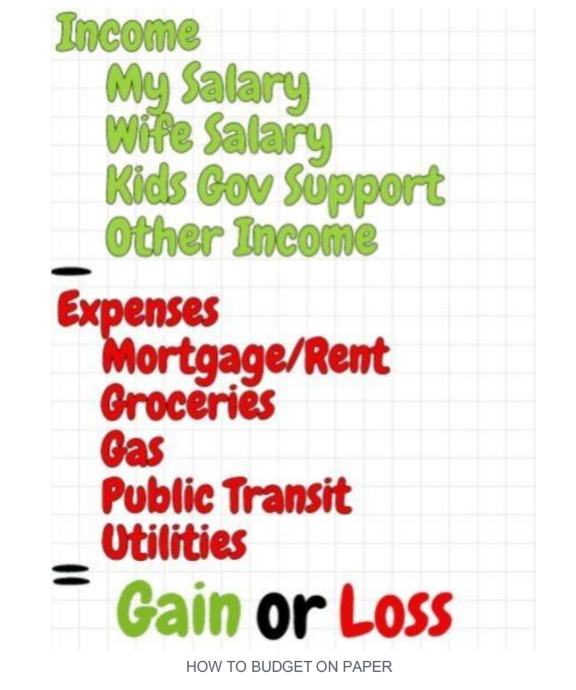
1) Get a grid or blank paper, pencil, rubber eraser and calculator
I am asking to work with pencil so expect a lot of editing and shifting things downwards and may be upwards
You also need a simple calculator that can do addition, subtraction, multiplication and division
You can use your cell phone calculator
2) Give your budget a title with month and year
At the top middle of your page, give your budget a title
Make it simple, it is Family Budget or Household Budget followed by month then comma and year
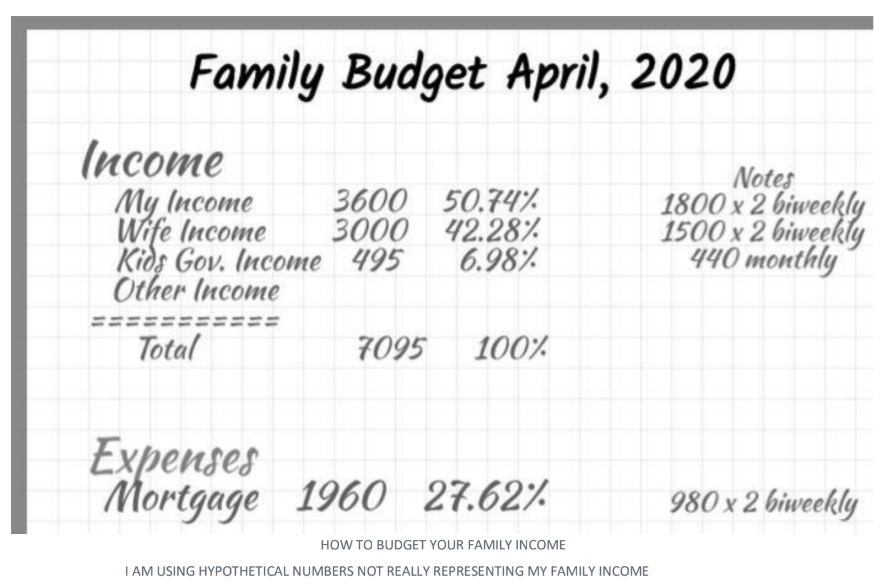
e.g. Family Budget April, 2020 I like to use “family“ more than “household” word, again it is up to you
3) Sketch your paper in advance for expenditures
Income is 2 to no more than 5 – 6 lines while expenses are a big list
Divide 1 to 4 portions
This means start dividing your paper into quarter for Income and four quarters for all expenses
Use indentation to make budget readable
Use indentation to help you glance each section easily
Remember you want to take decisions based on your income and expenses
List fixed expenses on top – optional tip
We have few expenses that are very hard to lower like mortgage or car loans
While other expenses are possible to lower like home and car insurances
Start listing all expenses sorted by hardest to lower down all the way down to these than you can negotiate or replace/cancel them
4) Get familiar calculating percentages
Don’t freak out when dealing with any percentage
Basic rule is, all combined income is 100% that act as the base value used for any percentage
Any expense should be divided by total income and then multiplied by 100
e.g. my family total income is 7095 which represents 100%
It acts as the base for all other numbers to divide upon it
My salary is 3600 as 1800 every two weeks so it is equal to 50.74%
I came up with this percentage as I divided 3600 which represents my income over the total income the 100% value which is 7095
So, 3600 divided by 7095 = 0.507399577167019 x 100 = 50.74%
Keep things simple, I just pasted what my calculator displayed for me
Again 3600 divided 7095 = 0.50739 x 100 = 50.739%
If the number after the 2 digits greater than 5, round the digit left to it by 1
e.g. my result is 50.74 since 9 is greater than 5
Finally, to make sure you have correct percentages
Make sure that all percentages in every income totals up to 100%
e.g. 50.74% + 42.28% + 6.98% = 100%
5) Choose and apply a budget type
I prefer the 10-10-80 budget rule but Why?
First, it addresses the fact that you only save 10% as the other 10% goes as donation
If you don’t donate, then you have a room for 20% savings
Second, the 80% gives you flexibility to adjust yourself to allocate 80% of your income as fixed and variable expenses along with the mortgage/rent payment
Simple Family Budget
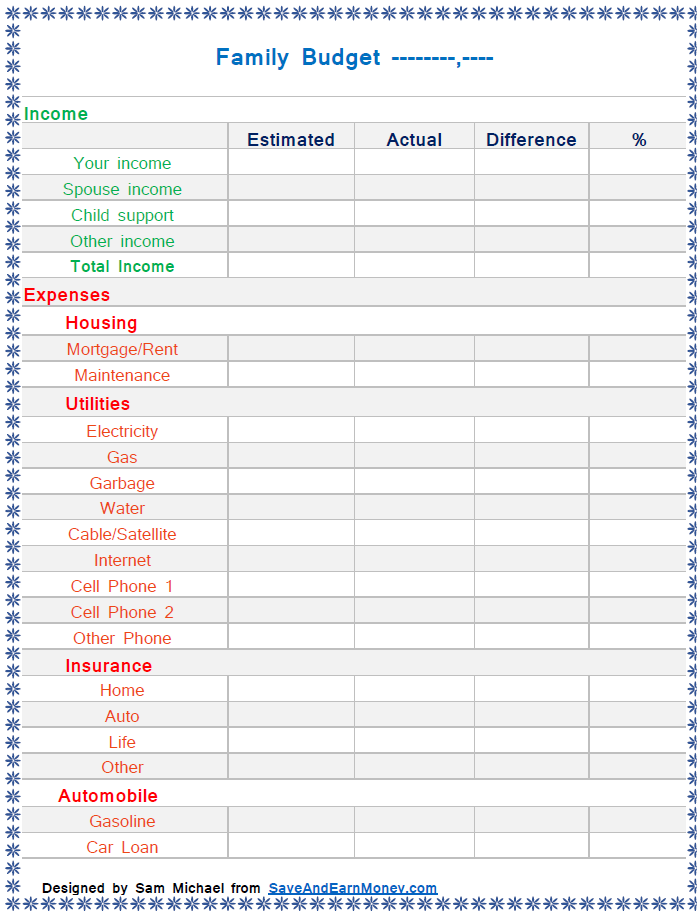
6) Fill in the blanks – my solution to your budgeting concern
Now you have all components ready and you know how to calculate the percentages
Doing your own budget can be fun and intriguing
It brainstorms your mind to think about saving money on everything
Click on the link below to use a family budget PDF right away
If it asks you to login, you can use your existing gmail account or create a new gmail
Or you can sign up with your own non gmail email
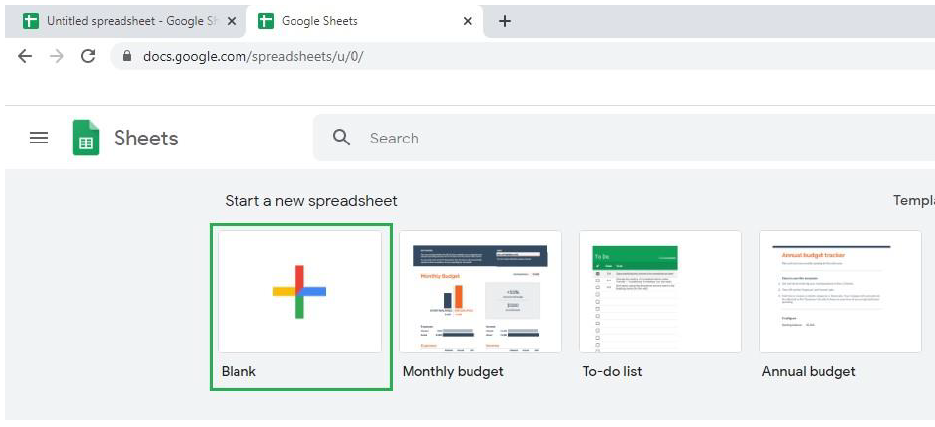
First click on Blank to create a new family budget for specific month and year
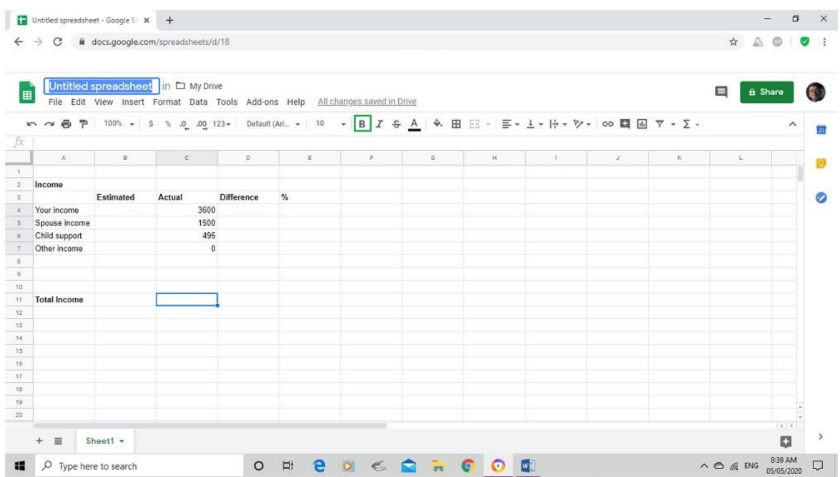
Rename your budget to Family Budget April, 2020
This is just an example, change it to whatever month and year you like
I prefer to start the Income header on row 2, in case I want to add a title on row 1
You can bold few cells by using the B button in green box
I made Income, Total Income, Estimated, Actual, Difference and % as bold
Click on cell C11 to prepare to sum all previous incomes
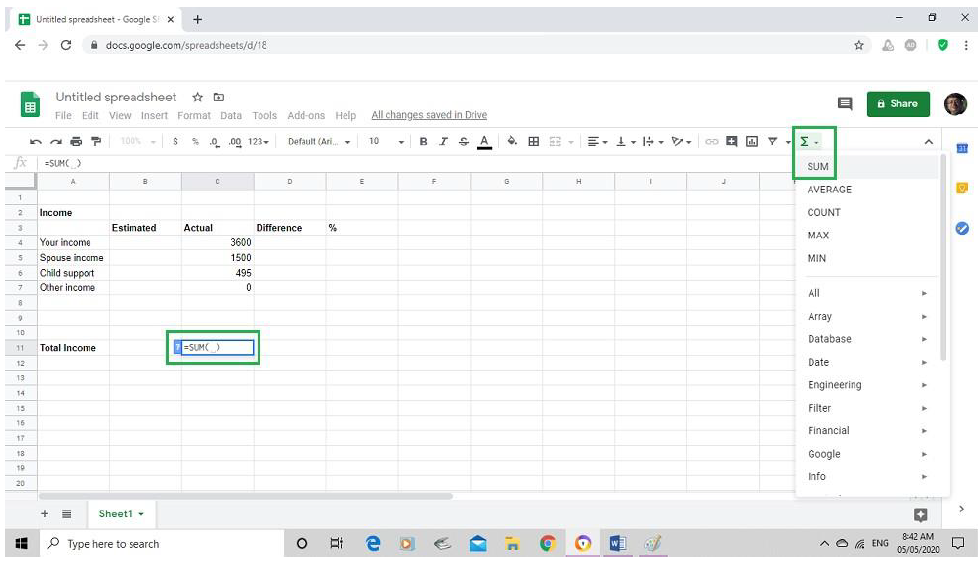
Go to the sigma sign and select SUM as shown below in green box
By default, all numbers starting from cell C4 3600 to cell C7 0 will be selected
To specify a range, just click on the beginning of the cells where you want to start your addition
Then hold the shift and click on the end cell where you want to end your summation process then hit enter
Now when it comes to doing the same process for expenses
You can add the expenses vertically to be under Income or horizontally
I want you to understand the concept and do whatever you like
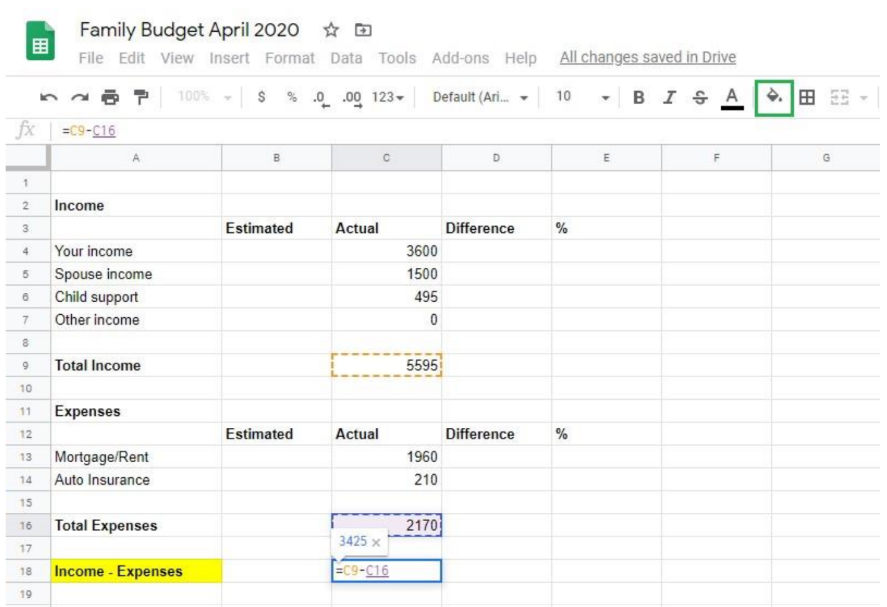
I added expenses below income as shown below
Cell A18 I added Income – Expenses and highlighted them in yellow by clicking on the paint bucket icon in green sqaure
I went to cell C18 and typed “=” followed by one click on total income amount C9 cell then press the minus sign “-“ followed by total expenses amount C16 cell
You can see the net value of 3425 showing on a tool tip
Hit enter key or return in mac to list the net result in cell C18
So far so good, right now you have a budget
You can expand it according to all of your expenses
Keep in mind all income and expenses are calculated as a percentage based on total income
I went to cell E4 and typed “=” followed by one click on your income amount C4 cell
Then press the divide sign “/” followed by a click on the total income amount C9 cell
Repeat the above 2 steps for all income as shown below
To convert all numbers to percentage
Click on cell E4 and hold down the shift key and press on the last cell which is Other income cell E7
All cells from E4 to E7 will be highlighted then click on the Format as percent button as shown below
Sum all the percentages for total income cell E9, it should be 100% as shown below
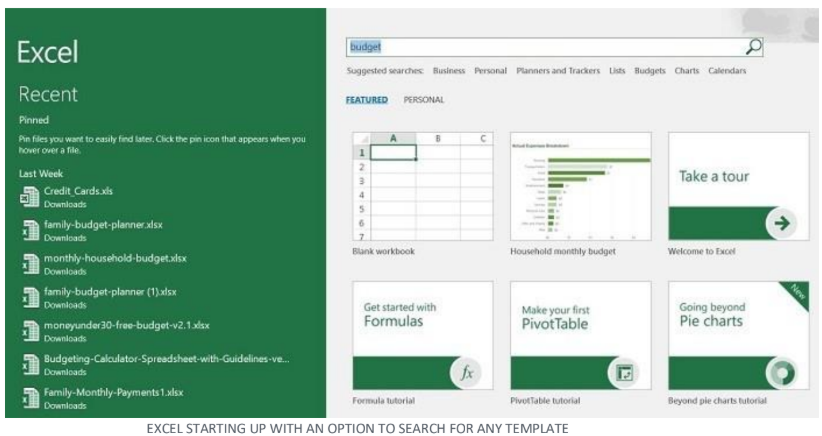
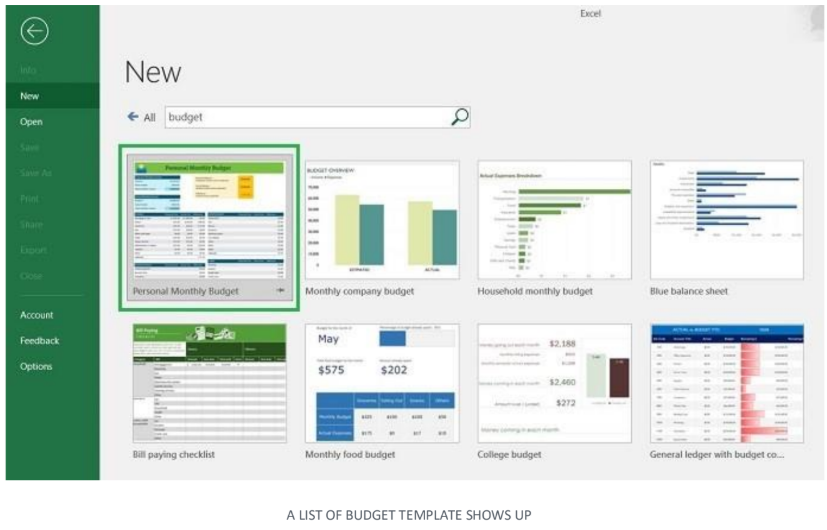
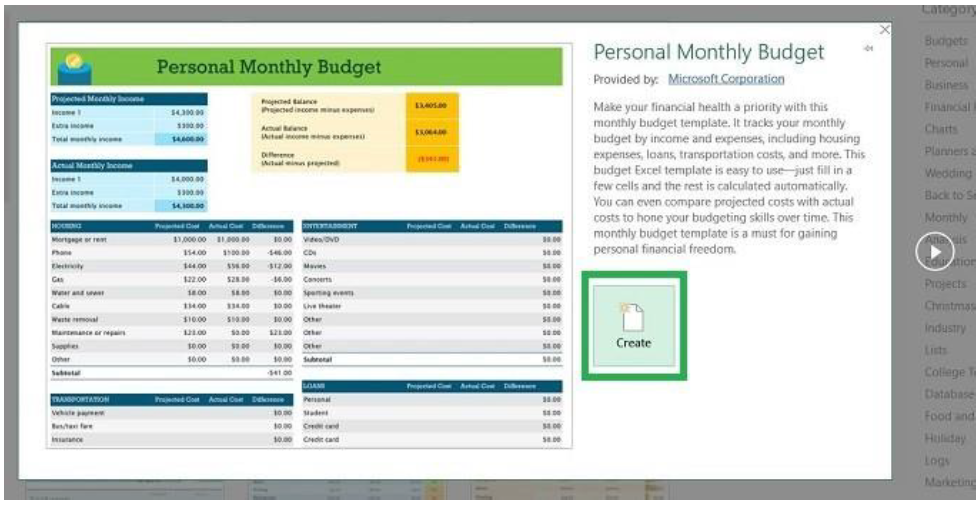
I have a family budget sheet for you to use right away, just click on the link below
He describes the spouse working on the a budget with the nerd and the free spirit
One partner creates a rigid budget with no room to breathe and vulnerable for mistakes to happen
Other spouse is the free spirit that cares about the want more than the need
This turns the how to budget process hard to cover all needs
Both spouses should create a budget to agree upon and to commit to follow it
3) Identify your income for the month
Is this a regular month where you will get paid biweekly twice a month
Or one of the 2 lucky months where you will get paid 3 times a month
Or are you getting a bonus
Sometimes some companies deduct more taxes on the first 6 months then they lower the deduction leading to high paycheck after July – August
4) Calculate your fixed expenses
Not all expenses are created the same
Mortgage/rent
Internet
Cable subscription
GYM
Netflix
Cell phone bills
Car payments
Home and auto insurances
All of the above fixed expenses are always the same amount every month
You have to deduct them from your income in your budget draft
This gives you a clear picture of how much left on your budget
5) Calculate your variable expenses
Variable expenses like the below ones should not be hard to predict
Groceries
Dining out
Electricity/heating
Water bill
Phone data plan (if not unlimited)
Costs of pet ownership
Gas
Credit cards
Recurring doctor or therapy co-pays
Prescription costs
Just do the following and you should be OK
I will start by groceries
Check your bank statement or the credit card which you use for paying your groceries for the last 3-6 months
If you find amounts for the past 6 months are pretty much close to each other then take the highest amount and consider it your monthly budget for grocery
If it is fluctuating with reasonable amounts, sum all the 6 months and divide them by 6
For example, $485 + $535 + $405 + $565 + $505 + $360 = $2855 / 6 ~ $475
Consider the above number your monthly estimated budget you carry it over on your draft budget copy
For variable expenses that are really fluctuating like health care expenses
You can have one month $40 dispensing fees for drugs and miscellaneous healthcare items while another month you get a root canal to fix
In this case, create the lower limit of $50 and create a buffer account to have it on your monthly budget to cover these emergencies
Remember you don’t have to touch the emergency fund if your buffer account covers your all of the sudden bill for this month
6) Apply your saving and adjust your expenses accordingly
Stick to a zero based budget as you have to assign a job for every dollar
All of the above mentioned budgeting methods stress on one thing you care about
For example, the value based budget and the reverse budget methods don’t address how you are going to handle your income to meet all expenses
I follow the 10% saving and donating 10% using pay yourself first then following the zero based budget
7) Track your spending frequently
Checking your budget before the end of the month would make it very hard to make any correction if you were already drafted in a deficit
Exception to the above if you are using the envelope system
But since few families use the envelope system, you must and should check your budget progress weekly
You still have a lot of rooms to fix anything before it is too late
8) Adjust your budget based on your mistakes
Mistakes happen even if you track your expenses and review your budget on a weekly basis
What I mean by mistakes, if you decide to budget your grocery to $475 per month
This means your weekly budget is set to $118.75
If you notice 2 weeks in a row you go over $125 and you notice that’s because you buy expensive types of cheese
I am totally against cutting something from your grocery
I always recommend to amend your grocery list to either reduce an item or replace an item you really don’t care about
For example, if you are buying a specific K-cup coffee for your Keurig K-cup machine and it doesn’t matter to replace it with cheaper brand but keep your same type of cheese
Then feel free to do so
You and your spouse are the master of your budget, embrace mistakes in budget as it will teach you to be a financial adviser for your house
9) Make your budget on paper not digital
Yes I meant here paper and not digital
You need paper budget and stick it to a place you always visit at home
The digital spreadsheet budget will help you to make adjustment as fast as possible
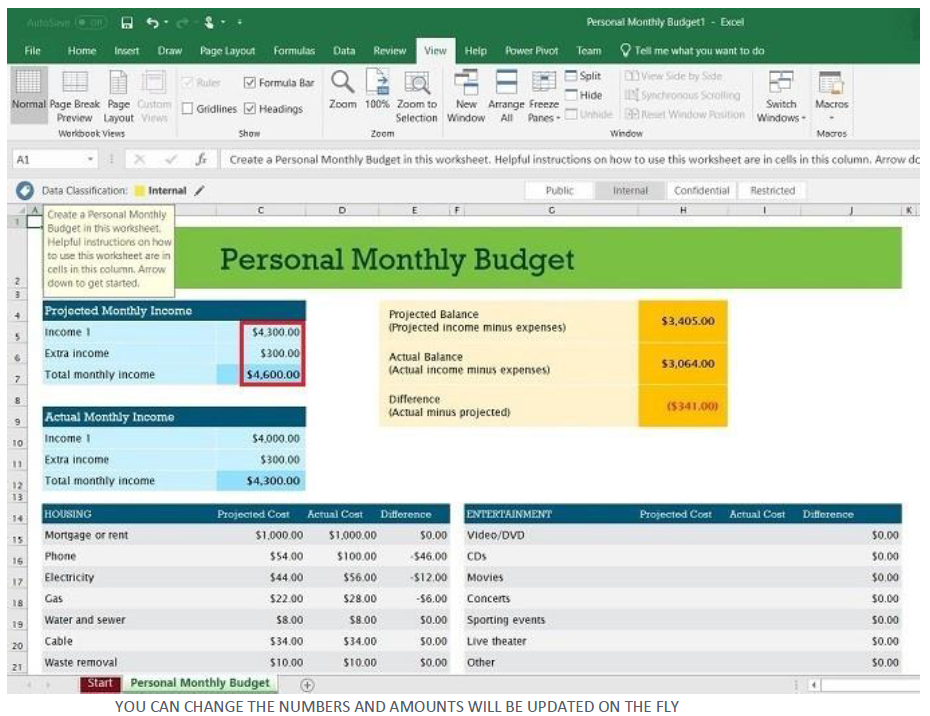
In less than a second, you change an item all total amounts will be updated instantly
How do you stick to your budget?
If you followed me in my journey on how to budget your family income on paper and digitally
I don’t know you, I know myself and I know I can stand to good degree against temptation
Nobody is going to force you to follow your family budget but top financial planners found some clues to assist you to stick to your budget
1) Creating your budget with your partner
I mentioned earlier, budget is not a personal decision
If both spouses they don’t agree on every single item on their budget
My advice to both of you, don’t commit to it
My wife knows how much I love blogging and the cost incurred to that
I make sacrifices to other things , my point here is that we have to absorb each other
2) Set a visual board for your financial goals
Nobody can really explain to you the importance of setting a visual board
You have to try it yourself and see how effective it is
Not only to help you stick to your budget but for setting and achieving your goals
Visual boards have the magic as being hypnotized to your dreams
If you look for hypnosis in dictionary, being able to focus deeply on what you are thinking about and this is the state you need to reach it
3) Share your saving goals with other buddy
According to Dave Ramsey’s book Total Money Makeover
He talks about “Keeping up with the Joneses” as you follow what close friends or family members do
It turns out that they were broke too
Look for responsible couples who take the budgeting matters seriously
I also found a forum called MrMoneyMustache that can help you express yourself and find serious people to talk about their experiences on how to budget your household income effectively
4) Add indulgence to your budget
If you really get to know me well
I apply things on myself to see how practical it is before recommending it to my readers
I won’t tell you to cut your morning coffee
According to myself, I reduced my morning Starbucks from 5 days a week to 1-2 times a week
My point here, you know yourself well, make enough room in your budget to help you adapt to any sudden drop in any item
For example, don’t slash going to restaurants item to zero if you love dinning out
I am totally against the other extreme
5) Make sure you set a realistic budget – this requires that you review your monthly budget before the beginning of every month
I said earlier, not every month you will face the same challenges
You can get 3 paychecks in one month, yes it happens twice a year, and you will be able to get your budget on track
Other months you can have a couple of birthdays, I would ask you to skip the meat and poultries every other week or skip the deli
You know this is a temporary workaround and you will be back to normal
That’s what I meant by setting a realistic budget, cut things you can avoid for short period of time
6) Setup automatic transfers for expenses
I discussed earlier how to plan for all expenses whatever fixed or variables
You must be confident to set up all your utilities to be paid automatically
I almost have all of my bills deducted from my checking account automatically
If you want to be on the safe side, you can ask your bank to add the overdraft limit service on your checking account
Bank will charge you one-time fee if any automatic payment overdraft your checking account limit
Point is you don’t want to miss any bill and you end up paying a penalty
7) Create a social calendar
Christmas or Hanukkah always comes on December
Rule of thumb, you have no surprises and that’s why I recommend creating a social calendar
Stick a calendar on your fridge for the upcoming month, resize it reasonably to have each day of the month enough to write the event(s) on that day
The best thing about keeping the social calendar in front of you is that you can add anything that comes on the fly
Like being invited for dinner from a friend where you have to buy a gift for them
You can have 2 colors on your calendar, green for planned events and red for upcoming sudden events
8) Track your spending digitally – excel sheet or mobile apps
You need to track your budget at least once a week
Review it on a digital format so when you make adjustment you get instant update
You need to love the budget concept and not have yourself when summing up all the expenses over and over when you make any slight change
9) Measure your success – measure it on a short and long term periods
The true measure of budget success by experiencing if you encountered any pressure to meet your budget
You can easily follow my steps on how to budget your family income
But how hard was it to reach the zero sum budget If you have difficulty reaching your end of month goals
This is a significant indication that you to review your budget again and again till it works for you with little to no effort
Finally, I hope you find my little effort teaching you how to create a personal budget to be useful
I encourage you to buy the Word and Excel files to start working on your family budget right away for only $2